
 Servicing & MOT
 Repairs
 Tyres & Wheels
 Engine & Drivetrain
 Diagnostics & Emissions
 Security & Tech
Why Is My Car Making a Grinding Noise When I Brake?
By Mike, Owner, The Car Guys Bromsgrove · 29 April 2026 · 5 min read
What the grinding noise actually is
Brake pads are designed with a metal wear indicator — a small tab of hardened steel that contacts the disc when the friction material wears down to a safe replacement threshold. That initial contact produces a high-pitched squeal. If that squeal is ignored and the pad wears through completely, the metal backing plate contacts the disc directly. That is the grinding noise.
At that point you are metal on metal. Every rotation of the wheel is scoring the disc surface. What started as a pad replacement that might cost £80 to £120 per axle can become a disc and pad replacement at twice the cost — or more if the disc is deeply grooved.
Other causes of grinding when braking
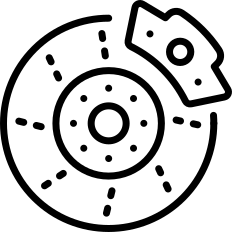
Worn pads are the most common cause, but not the only one. A sticking brake calliper can hold a pad against the disc continuously, causing grinding even when you are not pressing the pedal — you may also notice the car pulling to one side or a burning smell after a journey. Disc corrosion from a car that has sat unused for a week or two can produce a grating sound on the first few braking applications, but this usually clears within a mile. If it does not clear, the corrosion is more serious.
Debris between the pad and disc — a small stone, grit, or road debris — can cause a localised grinding or scraping sound that comes and goes. This can sometimes work itself clear but often needs the wheel removing to inspect properly.
Summary of grinding causes:
- Brake pads worn through to the metal backing plate
- Sticking calliper holding the pad against the disc
- Disc corrosion after a period of inactivity
- Debris trapped between pad and disc
- Disc scored or cracked from prolonged metal-on-metal contact
Is it safe to drive with a grinding brake?
In short: no. A grinding brake is reducing your stopping ability with every mile you drive. Scored discs have less friction surface area than an intact disc, meaning longer stopping distances. A sticking calliper can cause the car to pull sharply under braking, which is a serious handling risk. If you are hearing grinding consistently every time you brake, treat it as urgent.
The practical rule: if the grinding started this week, book it in as soon as possible. If the grinding has been there for several weeks, do not make long motorway journeys — the risk of brake fade or a complete pad failure increases with heat and heavy use.
Grinding brakes are an MOT failure item. If your test is coming up, the car will not pass with metal-on-metal contact on any axle.
What we check and how we quote
When you bring the car to us at The Car Guys, we remove each wheel, measure pad thickness and disc thickness against the manufacturer minimum, and check for scoring, cracks, or corrosion. We do not quote blind — you get measurements and a clear explanation of what needs replacing and why before any work is agreed.
We always replace brakes in axle pairs. If the front-left pads are worn, the front-right pads come off at the same time. Brakes on the same axle work together; mismatched wear causes the car to pull under braking. Call us on 01527 336608 or book online to get the car looked at.